 Calculate
When several debts demand payments at once, it can feel like nothing is changing. The debt snowball method simplifies the next decision: pay every required minimum, then direct extra money toward the smallest balance first. Here is how to build a responsible plan, compare it with the avalanche method and avoid common calculation mistakes.
The short answer
List each debt with its current balance, annual percentage rate (APR), required monthly minimum and due date. Set aside essential living expenses and an emergency buffer; never skip required minimums. Sort debts from smallest balance to largest. Pay the minimum on every debt, then send your available extra money to the smallest balance until it is paid off. Roll that payment into the next debt while keeping total monthly debt payments steady where feasible.
Before you begin: This is general financial education, not personal financial advice. Prioritize housing, food, utilities, insurance and required payments. Late fees, changing APRs, promotional rates and loan terms affect any projection. Contact lenders or a nonprofit credit counselor if you cannot meet minimum payments.
First, identify the problem
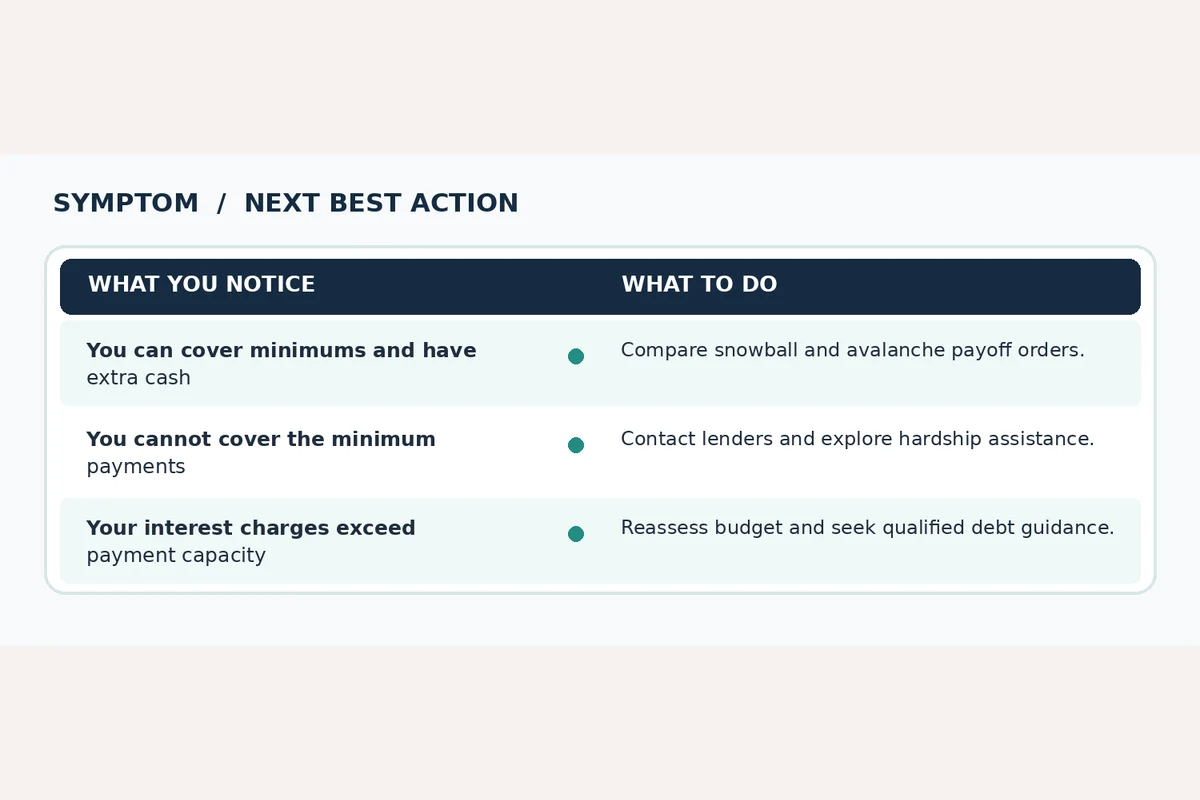
The right repayment tool should show not only an order but also the actual money available after essentials and minimum payments.
Step-by-step solution
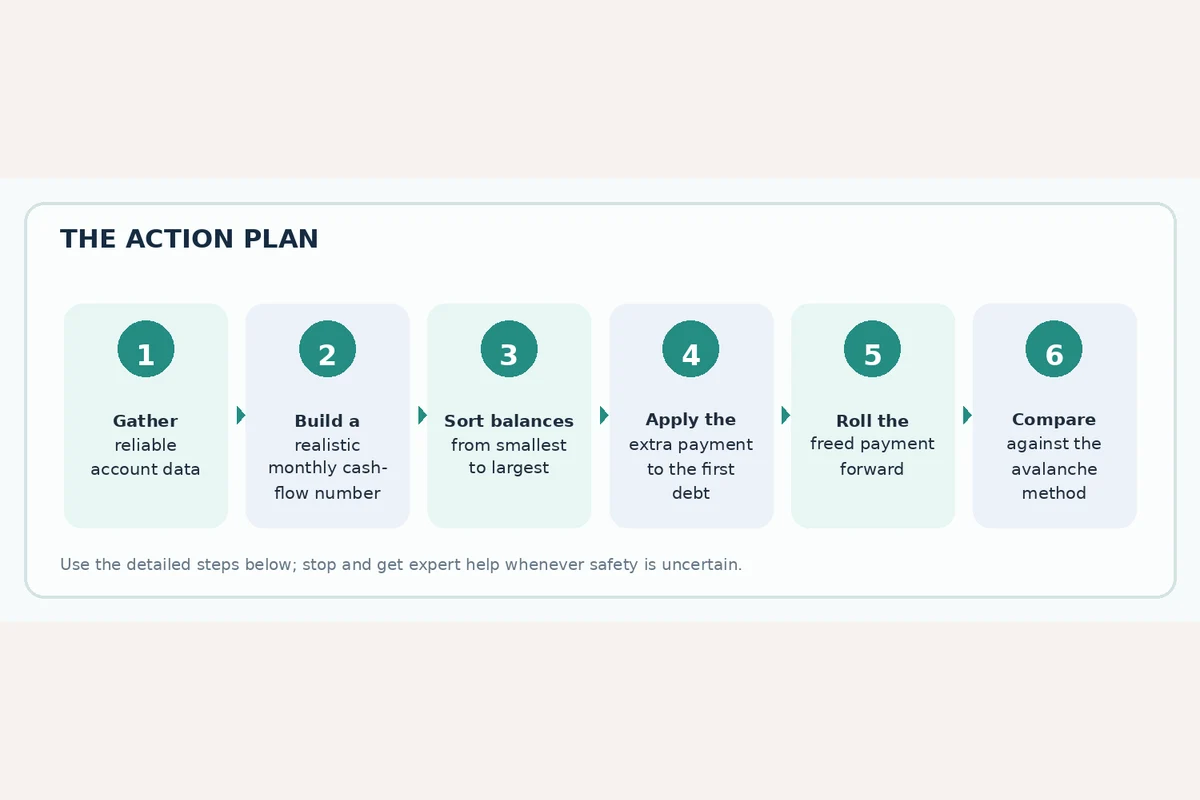
1. Gather reliable account data
Open current statements, not old screenshots, and write down each balance, APR, required minimum and payment due date. Check whether interest is calculated daily, whether the rate is promotional and whether there are prepayment penalties. Record the lender name but do not place account numbers or passwords in a shared worksheet. Create a separate row for each card or loan so you can compare them consistently.
2. Build a realistic monthly cash-flow number
Start with after-tax monthly income, then subtract essential expenses, irregular bill allowances and the required minimum on every debt. The remainder—not your income alone—is the possible extra payment. For example, if income after tax is $4,000, essentials and reserves consume $3,100 and minimums total $600, the theoretical extra is $300. Only use that $300 if the expense estimate is reliable and emergencies are still manageable.
3. Sort balances from smallest to largest
Imagine three debts: Card A $800 at 24% APR with a $40 minimum, Card B $2,500 at 19% APR with a $75 minimum, and Loan C $5,000 at 10% APR with a $150 minimum. Under the snowball method, A comes first despite its rate. Continue paying B and C on time. This creates a clear early milestone, but it may cost more interest than targeting the highest APR first.
4. Apply the extra payment to the first debt
Using the example and $300 of extra monthly cash, pay the $40 required minimum plus $300 extra toward Card A, while continuing the required $75 and $150 minimums elsewhere. Actual balances fall according to interest, payments and timing, so do not simply divide $800 by $340 and claim an exact payoff date. A spreadsheet or calculator should model each month’s accrual and remaining balance.
5. Roll the freed payment forward
When Card A is paid in full, redirect its former $40 minimum plus the $300 extra to Card B, on top of Card B’s own minimum. Keep Loan C’s minimum current. In this example, the new amount aimed at Card B would be $415 per month, subject to any change in minimums or budget. After B is cleared, redirect the combined allocation to C. Do not increase spending merely because a payment disappeared.
6. Compare against the avalanche method
The avalanche method directs extra payments to the highest APR first and often reduces total interest costs, assuming the same payment budget. Compare projected months, total interest and your ability to stick with the plan. The snowball’s early wins may improve motivation; the avalanche may be financially cheaper. If either plan causes missed minimums, it is not suitable. Recalculate whenever rates, balances or income change.
Common mistakes to avoid
- Forgetting to include every required minimum payment.
- Assuming an APR is a simple one-time percentage instead of an ongoing interest charge.
- Predicting exact payoff dates without accounting for compounding and changing balances.
- Ignoring an emergency buffer, then returning to high-interest borrowing when a bill arrives.
- Paying one balance aggressively while missing another debt’s due date.
When to stop and get professional help
If you cannot afford all minimum payments, contact creditors about hardship options and consult a reputable nonprofit credit counselor. Be cautious about companies promising guaranteed debt elimination or asking for large up-front fees. Legal, tax or bankruptcy decisions require qualified personal advice.
Prevention and maintenance checklist
- Use automatic payments for minimums when you can maintain the bank balance.
- Recheck APRs and minimum payments on each new statement.
- Keep an emergency fund appropriate to your circumstances.
- Track payoff milestones, but avoid spending the freed payment.
- Review the plan after any major income, household or rate change.
Frequently asked questions
Is the debt snowball method better than avalanche?
Neither is universally better. Snowball prioritizes small balances and early progress; avalanche targets high interest rates and often minimizes interest. Choose with realistic calculations and behavioral fit.
What if two balances are the same size?
You can break the tie by higher APR or another practical factor. The essential rule is to maintain every required minimum.
Will the calculator give an exact payoff date?
No. It estimates based on the APR, payment rules and assumptions provided. Actual interest accrual and lender minimums vary.
Should I use savings to repay debt?
This is personal to risk, interest rates and cash needs. Do not eliminate essential liquidity without considering emergencies; seek qualified guidance for complex decisions.
What to do next
Make your debt list today and calculate the extra amount available only after essentials and minimums. Then compare snowball and avalanche schedules side by side before selecting the approach you can sustain.
References and further reading
These primary sources support the safety, consumer-protection, or platform guidance in this article. Verify product manuals and local rules before acting.
Editorial note: General U.S. information, not individualized professional advice. Product models and local codes may differ. Images are original explanatory illustrations, not photographs of a specific product or job.